Nov
November: the season opens
The herring move in and the first boats start running north. Daylight shrinks fast through the month, and the polar night begins on the 27th. Departures are easier to get than in December, and the fares are the same.
Season
The whale watching Tromso season runs from the middle of November to the middle of January, with boats still going out into February and March. Orcas and humpbacks follow the herring into the fjords around Skjervøy and Kvænangen, and the fleet follows them. Fares start at $211 for a seven-and-a-half-hour catamaran day, and our top pick, the full day north at $361, carries 1,211 reviews at 4.7.
Quick answer
The peak of the whale watching Tromso season is from late November to the middle of January, and December is the month most crews would pick. The herring are in the fjords, the orcas and humpbacks are with them, and the polar night gives you three or four hours of blue and pink twilight that photographers travel for. Trips run from $211 on a fast catamaran to $361 for the full day north to Skjervøy, which is our top pick. Book a few weeks ahead: the season is short and the fleet is small.
Four windows
Every window on this list puts you on the same water with the same species. What changes is the light, the number of departures and how many people are on the quay beside you.
Nov
The herring move in and the first boats start running north. Daylight shrinks fast through the month, and the polar night begins on the 27th. Departures are easier to get than in December, and the fares are the same.
Dec
The month most crews would choose. Whales are settled in the fjords, the twilight sits pink and blue on the water for three or four hours, and every boat in the fleet is running. It is also the month that fills first, so book a few weeks ahead.
Jan
The first half holds the peak; the sun climbs back over the horizon on 15 January and the days lengthen quickly after that. Aurora odds stay high, the water is at its coldest, and sightings hold through the middle of the month.
Feb – Mar
Fewer departures and more daylight. Some seasons keep producing sightings well into February; others thin out early. The trade is a quieter quay, long blue hours and the best combination of whales and northern lights in one trip.
Why the season is this short
Herring first, then orcas, then humpbacks, then the fleet.
Northern Norway has whales in its waters all year. Tromsø has them close to shore for about two months, and the reason is food. Every autumn the Norwegian spring-spawning herring move into the sheltered fjord systems north-east of the city to overwinter, in numbers that turn the echo sounder solid black. Orcas follow them in, and humpbacks follow the orcas.
That is the whole mechanism, and it explains everything else about the whale watching Tromsø season. The whales are where the herring are, so the fleet moves when the herring move. Some winters the shoals sit in Kvænangen; some winters they favour the waters around Skjervøy; and the crews track them day by day and sail to where the birds are working.
By late winter the herring disperse and the whales head back out towards the Barents Sea for the summer. That is why a summer visit to Tromsø is a fjord-cruise visit rather than a whale-watching one, and why the fleet you see on this page is a winter fleet.
It also explains the distances. When the herring are far north, a whale watching day from Tromsø means a coach ride to Skjervøy and back — which is exactly what our top pick at $361 does, and why it runs twelve hours.
November
Building sightings, falling light, and seats still available.
Mid-November is when the first boats start making the run north and the season properly begins. The herring are arriving, the crews are re-learning where the shoals sit this year, and the sightings build through the month as more whales move in behind them.
Light is the thing that changes fastest. In the first week of November Tromsø still gets a low sun for a few hours; by the 27th the sun stays below the horizon and the polar night begins. The whole month is a gradient from short daylight to long twilight, and both are lovely on the water.
Practically, November is the friendliest month for a late booking. The same boats run the same routes at the same fares as in December, and there are more seats left on them. If your dates are fixed and the peak weeks are full, this is the window that usually still has room on $222 or $223.
December
Settled whales, blue twilight, and the fullest quay of the year.
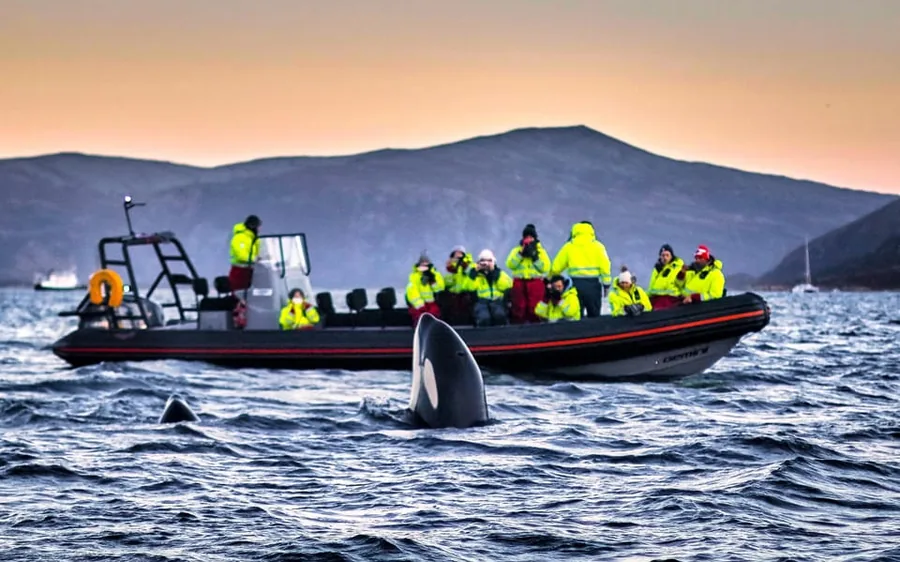
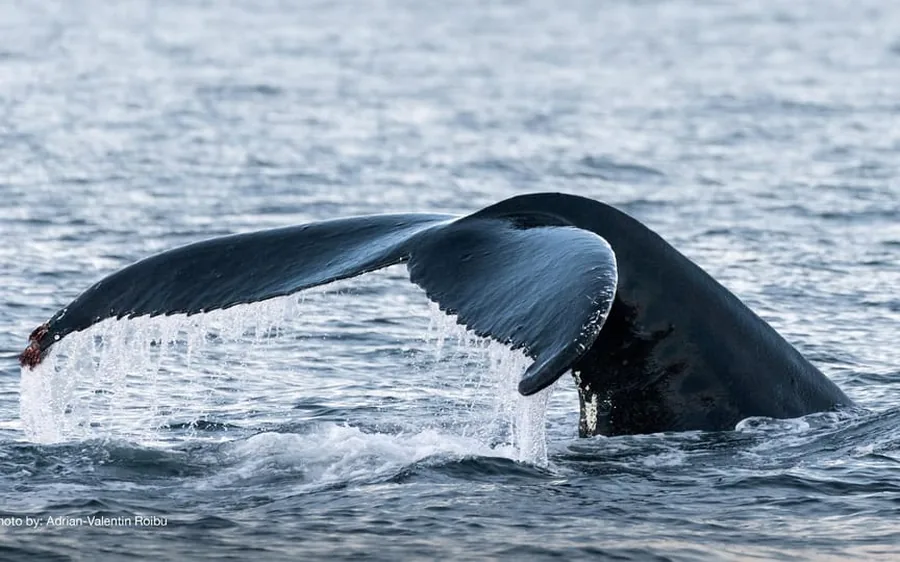
If you can pick a month for whale watching in Tromsø, pick December. The herring are settled, the orcas are working them in family groups, humpbacks are lunging through the same shoals, and every boat in the fleet is out.
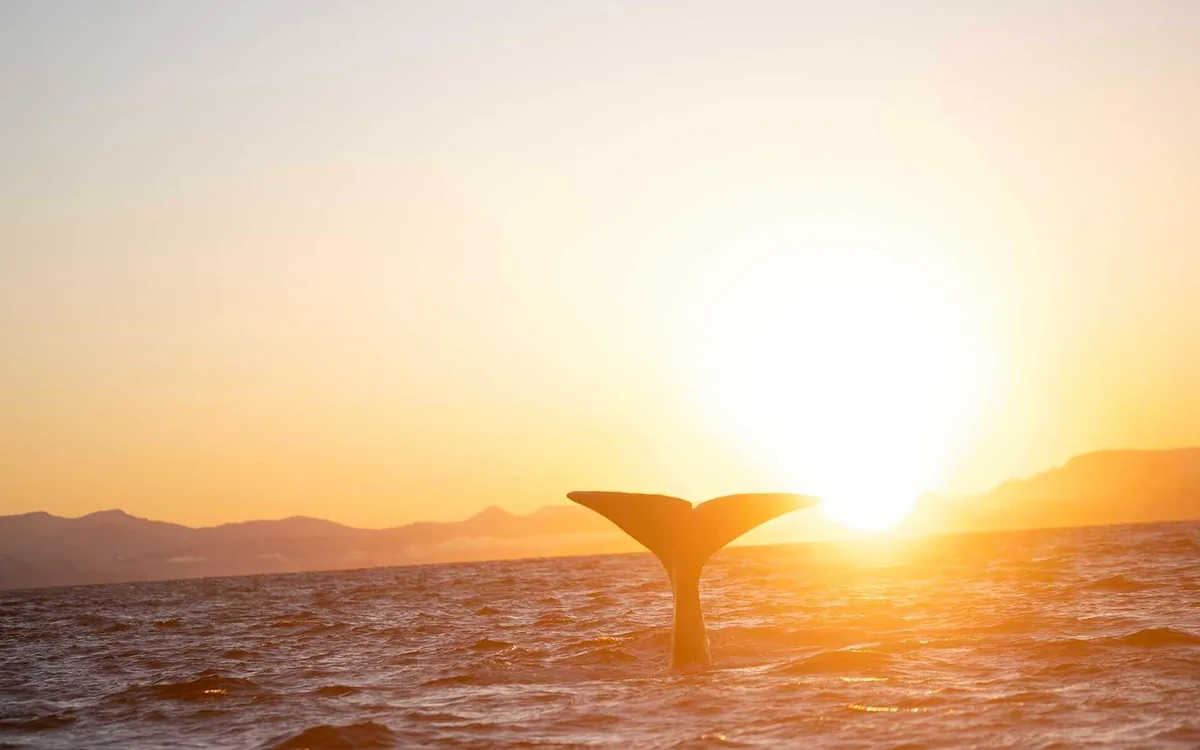
The light in December is the reason photographers plan whole trips around it. There is no sunrise, but there is a long civil twilight from roughly ten in the morning to two in the afternoon, when the sky and the snow and the water all go the same shade of blue, and the mountains behind Kvænangen turn pink for an hour. A tail fluke against that sky is the photograph people come home with.
The trade is demand. December fills first, and the small-capacity boats — $218 on the small ship, the RIBs at $340 and $244 — go earliest of all. Book a few weeks ahead and you can still choose your boat rather than take what is left.
Book direct
Our top pick, the most reviewed boat, the lowest whale watching fare here and the highest rated RIB day. The full table of fares is on the price page.
★ 4.7 · 1,211 reviews
★ 4.5 · 6,653 reviews
★ 4.7 · 662 reviews
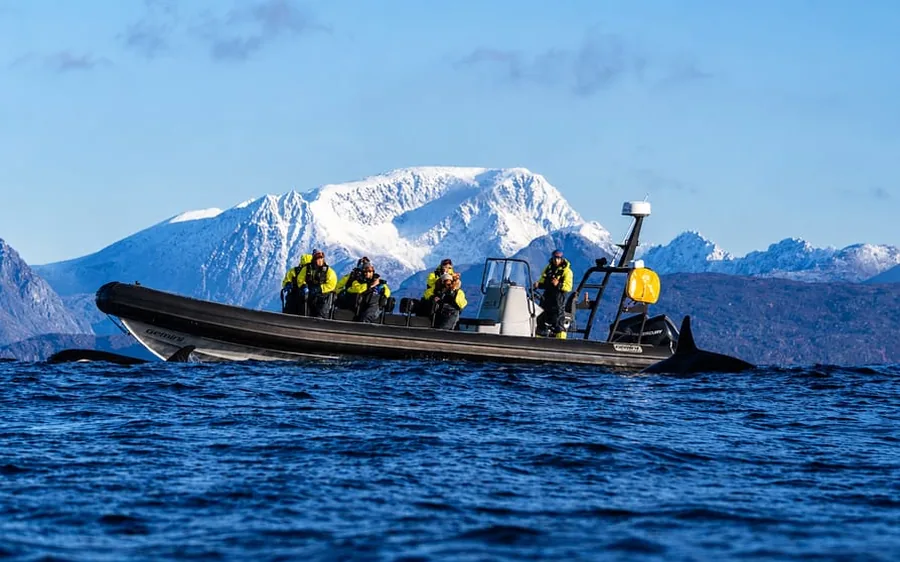
★ 4.8 · 1,281 reviews
January
Peak sightings, the coldest water, and the sun returning.
The first two weeks of January are still peak season. The herring are in the fjords, the boats are running their winter schedule, and the water is at its coldest, which is precisely when the thermal suits and heated saloons on this page earn their keep.
On 15 January the sun lifts back over the horizon in Tromsø for the first time since November, and the town makes a small celebration of it. From that day the light grows by about twenty minutes each day, which changes the feel of a trip quickly: by the end of the month you are watching whales in daylight rather than in twilight.
Aurora odds stay strong right through January, and on a twelve-hour day such as $361 or $391 you are on the water or on the coach road during the dark hours at both ends, which is when people most often see it from the deck.
February and March
Fewer boats, more daylight, and longer trips to widen the odds.
By February the herring begin to disperse and the fleet thins. Some winters keep producing good sightings well into the month; others slow earlier, and the crews are straightforward about which kind of winter they are having. Fewer boats run, and the ones that do often have room at short notice.
What February and March give you instead is light and quiet. Daylight is back to six or eight hours, the low sun sits gold on the snow for most of it, and the quay is calm. Aurora season continues through March, so an evening on shore still has the sky above it.
If your trip is already booked for late winter, the sensible approach is to take a longer trip rather than a short one: $361 or $391 put twelve hours between you and the odds, and a longer search covers more water.
What the season does not change
Month-by-month advice is useful at the margins. These five hold from November to March.
Orcas and humpbacks, travelling with the same herring shoals, in the same fjord systems. February orcas are the same orcas as December orcas.
Prices hold steady across the season: $211 to $391 for whale trips from Tromsø. What changes is availability, and that is a reason to book a few weeks ahead rather than to wait for a cheaper month.
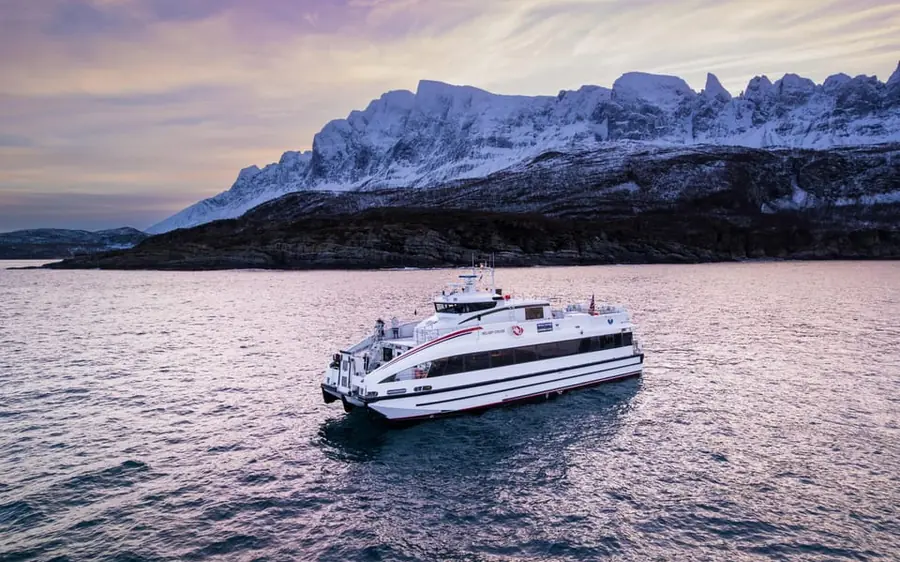
Sea temperature sits around four to six degrees all winter and the wind does the rest. Every boat here either lends a full thermal suit or has a heated saloon, and most have both.
The Tromsø quays are a short walk from the centre, beside Storgata. The Skjervøy departures at $260 and $282 meet up in the north; the twelve-hour trips include the road transfer.
Crews publish their sighting records from recent weeks and are frank about what they have been finding. In the peak weeks most departures spend time with whales, and the honest way to read that is as strong odds rather than a promise.
Twelve hours north to the fjords where the herring overwinter, with the transfer from Tromsø included — 1,211 reviews at 4.7.
Check dates for our top pick→Common questions
Late November to the middle of January, and December most of all. That is when the herring are settled in the fjords and the orcas and humpbacks are with them.
Boats start running north in mid-November and the peak holds to about mid-January. Departures continue into February and March, with fewer boats and more daylight.
Summer trips from Tromsø are fjord cruises. The whales spend the summer out in the Barents Sea and return to the fjords with the herring in late autumn.
The sun stays below the horizon from 27 November to 15 January, and the middle of the day is three or four hours of blue and pink twilight. It is bright enough to watch whales and to photograph them, and it is the light people plan the trip around.
December and early January, when orca groups are working the herring shoals daily. $266 and $391 are built around those weeks.
A few weeks for December and early January, particularly for the small boats and RIBs. The season is short and the fleet is small, and every listing here carries free cancellation.
Yes. Aurora season runs from September to March, so the whole whale season sits inside it. The long twelve-hour trips give you dark hours at both ends of the day.
In short
Arrive, peak, and the return of the sun.
Mid-November. The herring arrive, the first boats run north, and seats are easy to find. A good window if your dates are fixed late.
December to mid-January. The peak. Settled whales, the full fleet, and the blue twilight of the polar night. Book a few weeks ahead and pick your boat — our top pick at $361 or the most reviewed boat at $222.
15 January. The sun returns, and the season starts sliding towards daylight. From here to March you trade departures for light and quiet, and longer trips make more sense than short ones.
Everything else about the whale watching Tromsø season follows the herring, and the crews follow the herring day by day.
Go deeper
Fourteen ranked for one decision, with a straight answer for each kind of visitor.
PricesFourteen fares compared, cost per hour, and what the price includes.
OrcasWhat you actually see, how close the boats get, and why the two species travel together.
SkjervøyTwo hours north of Tromsø, and why half the fleet drives there in midwinter.
RIB or catamaranSpeed, warmth, cameras and seasickness: how the two kinds of boat differ.
Silent boatsWhat a quiet engine changes for the whales and for you.
From Tromso: Whale Watching in Magic Skjervoy
★ 4.7 · 1,211 reviews · Free cancellation 24 h