Our top pick1,211 reviews
12 hFrom Tromso: Whale Watching in Magic Skjervoy
★ 4.7 · 1,211 reviews
- Twelve hours, the full day north to Skjervøy
- Transfer from Tromsø included
- Longest tour here
- Free cancellation
$361$30.08 / hour
Check availability→ Orcas
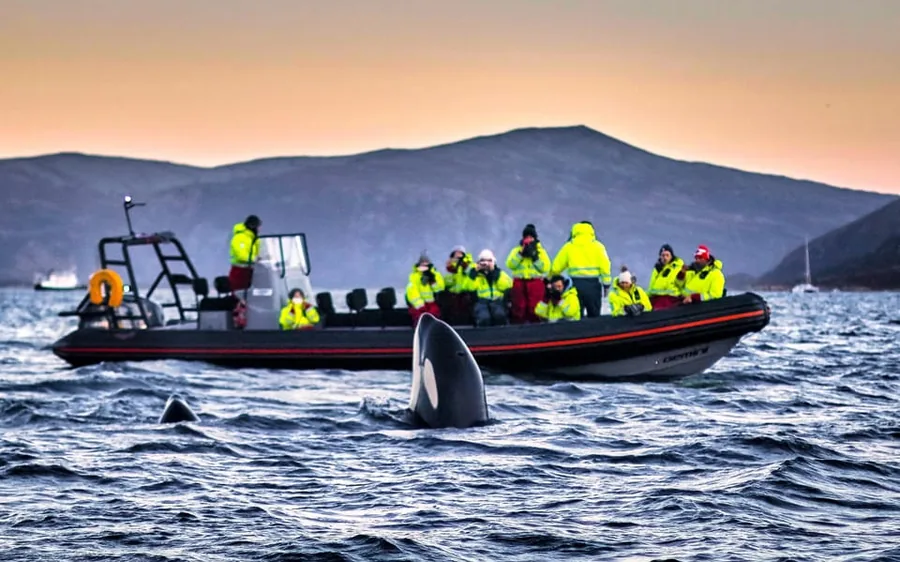
Orcas in Tromso arrive with the herring in late autumn and stay into January, working the shoals in family groups through the fjords north of the city. Humpbacks feed on the same fish and travel with them. Fourteen trips go looking, from $211 for a fast catamaran day to $361 for the full day north, which is our top pick.
Quick answer
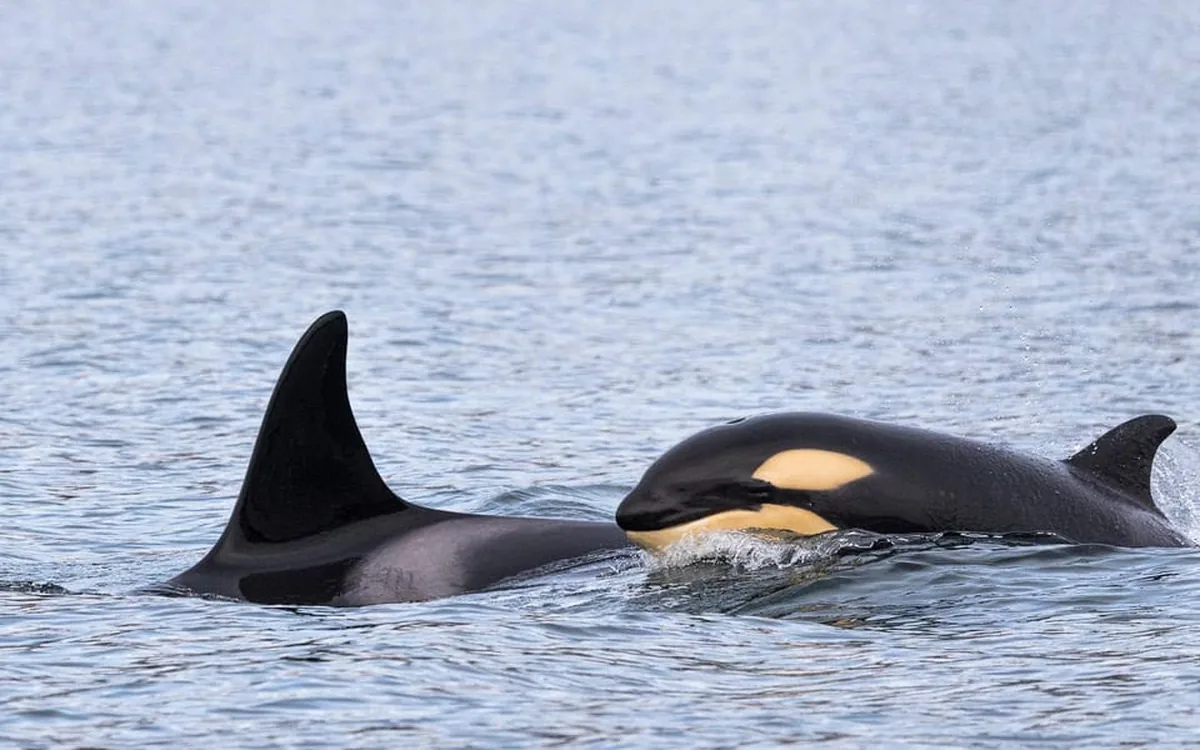
Orcas in Tromsø are here because the herring are, from mid-November to mid-January, in the fjords around Skjervøy and Kvænangen. They travel in family groups, they hunt co-operatively, and humpbacks work the same shoals alongside them. Boats keep a respectful distance and let the whales decide how close the encounter becomes. For killer whale watching in Tromso, the strongest odds come from a full day north: our top pick at $361, 4.7 from 1,211 reviews, or the RIB day at $340 at 4.8.
What you are actually looking at
Orcas herd the herring; humpbacks arrive for the same ball.
The orcas here are fish-eating killer whales, and in these waters they specialise in herring. They work as a group: circling a shoal, pushing it up towards the surface into a tight ball, then swimming through it and stunning fish with their tail flukes. It is co-ordinated, noisy and visible from the deck, and it is the reason the birds above a feeding group are usually what the crew spots first.
Humpbacks take advantage of the same work. Where orcas have gathered herring into a ball, a humpback can lunge up through it with its mouth open and take a large part of the shoal in one pass. Seeing both species in the same few hundred metres of water is ordinary in this season rather than exceptional.
Group sizes vary. A quiet encounter might be four or five orcas moving steadily along a fjord wall. A busy one can involve dozens spread across the water with several humpbacks surfacing between them and hundreds of gulls overhead. Both are normal, and the crews describe what they are seeing as it unfolds.
Fin whales pass through these waters as well, and some seasons bring them within sight of the boats. They are the bonus rather than the reason.
Book direct
Our top pick, the highest rated RIB day, the all-inclusive boat and the small ship that keeps the gentlest distances.
★ 4.7 · 1,211 reviews
★ 4.8 · 1,281 reviews
★ 4.6 · 1,722 reviews
★ 4.7 · 53 reviews
How close the boats get
Slow, steady and from the side, with the engine cut on approach.
Norwegian whale watching operates on a code that every boat on this page follows: approach slowly and from the side rather than head-on, hold a steady distance, avoid driving through a group and separating mothers from calves, and let the animals move towards the boat rather than the other way round.
In practice the good encounters are the ones where the engine goes quiet and the whales carry on with what they were doing. On the hybrid-electric boat at $222 the crew can run the final stretch on batteries, so the last hundred metres happen in something close to silence. The small ship at $218 makes the same point in a different way, with a smaller hull and a crew who talk openly about distances.
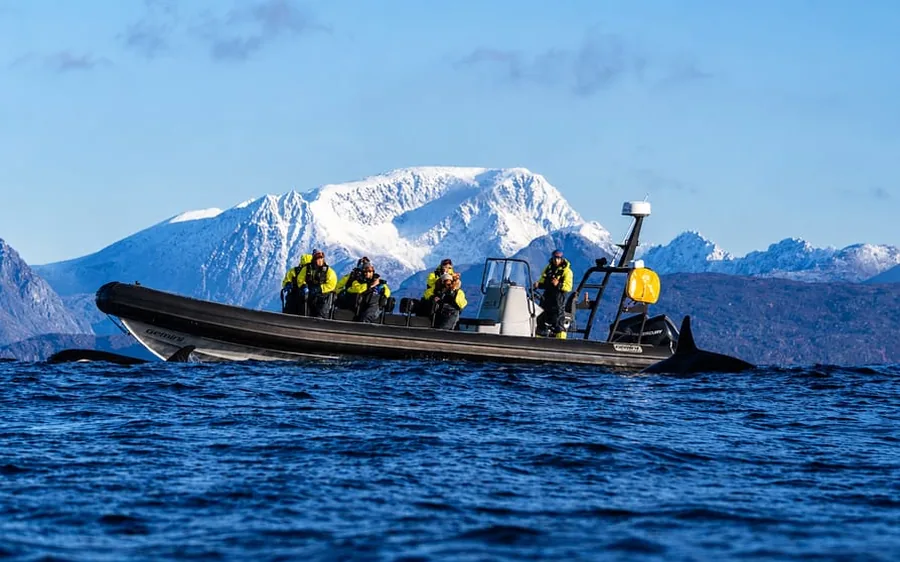
On a RIB such as $340 or $244 you sit about a metre above the surface, which changes how close a legal distance feels: a dorsal fin passing twenty metres away at eye level is a different experience from the same fin seen from a deck three metres up. That difference, rather than any rule, is what people are paying for when they book a RIB.
What tells the crew where to look
A whale watching day is mostly a search, and the search follows the same cues every time.
Gulls and kittiwakes gathering and diving over one patch of water usually means herring have been pushed up. Orcas are often directly underneath.
A herring shoal shows on the sounder as a dense, dark mass. Where the fish are, the whales follow within hours.
A humpback blow is a tall, bushy column that hangs in still air. Orca blows are lower and quicker, and in cold air both are visible at surprising distances.
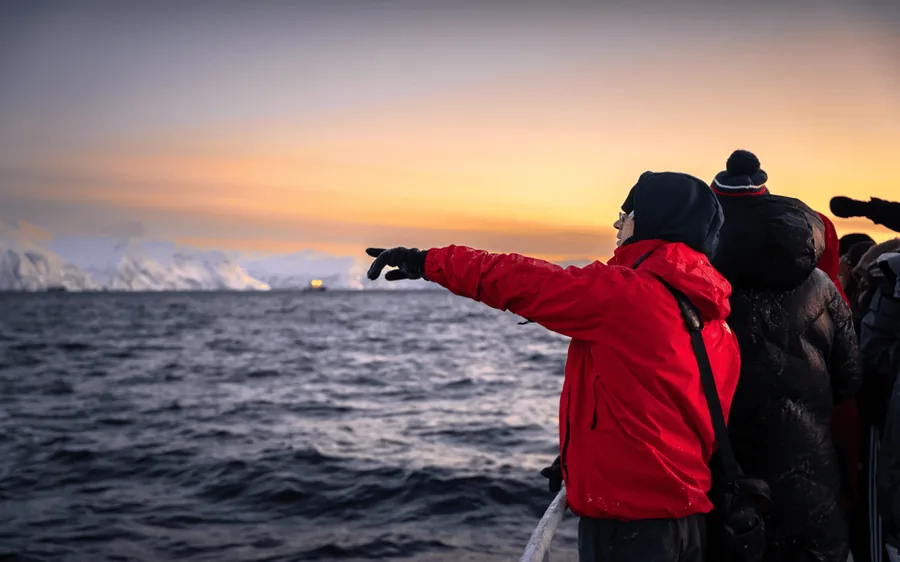
The fleet is small and the crews share sightings. A report from a boat an hour ahead is often what decides where your day goes.
Whales stay with a shoal for days at a time. Crews start each morning where the animals were the previous afternoon, which is why sighting rates hold steady across weeks of a season.
The other species
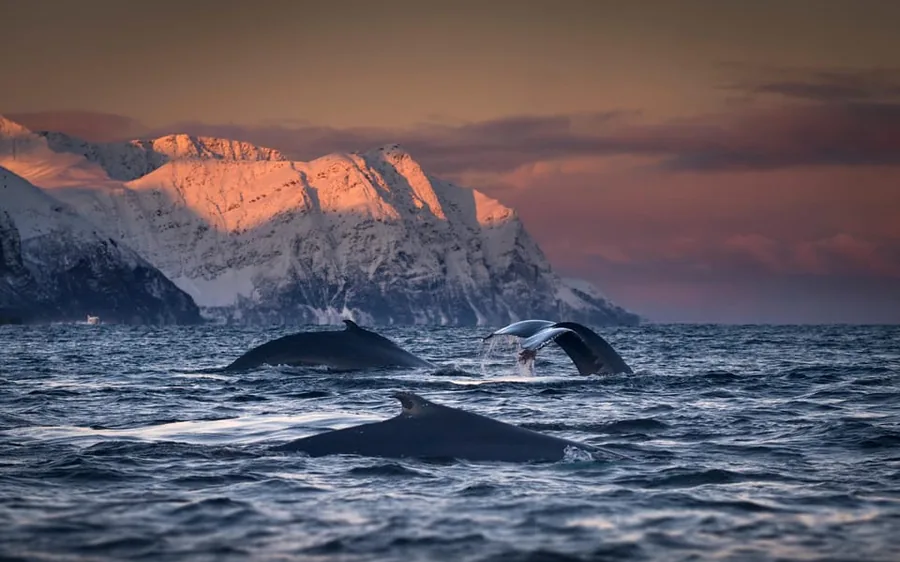
Lunge-feeding, the raised tail, and a pink sky behind both.
Orcas are the reason most people book, and humpbacks are usually the animal they come home talking about. A humpback is roughly fifteen metres long and thirty tonnes, and everything it does at the surface is large and slow enough to watch properly.
The behaviour that makes the photographs is lunge-feeding. The whale comes up from beneath a herring ball with its mouth wide open, breaks the surface at an angle, and falls back with water pouring from its jaw. It happens in seconds and often several times in a row, and on a boat with a quiet approach such as $222 you hear the intake of breath before you see anything.
The second gift is the tail. A humpback lifts its flukes clear of the water before a deep dive, and against a sky that is pink and blue for three hours it makes the shot that ends up framed at home. The underside of each tail is patterned differently, and researchers identify individual whales from it, which is why crews photograph them too.
Humpbacks tolerate boats well when the boats behave, and they occasionally surface close enough that the whole deck goes quiet. On the small ship at $218 and on the RIBs at $244 those moments are the ones guests describe afterwards.
Twelve hours north to the fjords where the orcas and humpbacks work the herring, with the transfer included — 4.7 from 1,211 reviews.
Check dates for our top pick→What the odds really look like
Long day, northern start, middle of the season.
This is wild water, and the fair way to talk about it is with numbers rather than promises. Through the peak weeks of December and early January, the great majority of departures spend time with whales, and several operators publish their sighting logs from recent seasons so you can see the pattern for yourself.
The odds improve with three things. Time on the water: twelve hours at $361 covers far more ground than four at $260. A northern start: boats leaving from Skjervøy begin among the shoals. And the middle of the season, when the herring are settled rather than arriving or dispersing.
Some operators offer a second trip at a reduced rate if a departure finds nothing, and the listing states it when they do. The practical version of that advice is simpler: if whales are the reason you came to Tromsø, give yourself two possible days rather than one, and put the long trip on the first of them.
Common questions
From the middle of November to the middle of January, with the strongest weeks in December and early January. Trips continue into February and March with fewer departures.
In the fjords north-east of the city, particularly around Skjervøy and Kvænangen, wherever the overwintering herring are that week.
Our top pick at $361 for a full day north, or the RIB day at $340 at 4.8 for the closest view of the water.
Often, yes. The orcas gather the herring into a tight ball and humpbacks lunge up through the same ball, so both species work the same patch of water.
Norwegian guidelines keep the boats at a steady distance, approaching slowly and from the side. Whales frequently choose to come closer, and from a RIB at a metre above the water even a legal distance feels close.
The killer whales here feed on herring and pay boats little attention. Crews follow the national code, keep the approach calm and let the animals set the terms.
It varies with the herring. A quiet encounter might be four or five animals moving along a fjord; a busy hour can spread dozens across the water with humpbacks between them.
In short
Herring, the fjords north, and hours on the water.
They are here for the herring. From mid-November to mid-January the shoals overwinter in the fjords north of the city, and the orcas and humpbacks follow them in.
The fjords north are where the fleet goes. Skjervøy and Kvænangen, about two hours by road, which is why our top pick at $361 and the RIB day at $340 run twelve hours and include the transfer.
Longer trips widen the odds. Time on the water is the single thing you control. Whichever boat suits you, book a few weeks ahead: the season is eight or nine weeks long and the best-rated trips fill first.
Go deeper
When the whales arrive, when they leave, and which month suits which boat.
VerdictFourteen ranked for one decision, with a straight answer for each kind of visitor.
PricesFourteen fares compared, cost per hour, and what the price includes.
SkjervøyTwo hours north of Tromsø, and why half the fleet drives there in midwinter.
RIB or catamaranSpeed, warmth, cameras and seasickness: how the two kinds of boat differ.
Silent boatsWhat a quiet engine changes for the whales and for you.
From Tromso: Whale Watching in Magic Skjervoy
★ 4.7 · 1,211 reviews · Free cancellation 24 h